








IJRAR Peer-Reviewed (Refereed) Journal as Per New UGC Rules.
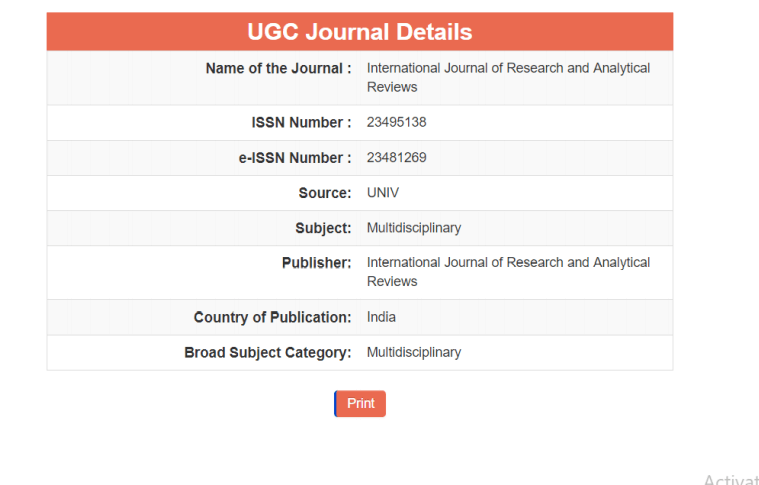
ISSN Approved Journal No: E-ISSN 2348-1269, P- ISSN 2349-5138
Journal ESTD Year: 2014 | CrossRef DOI
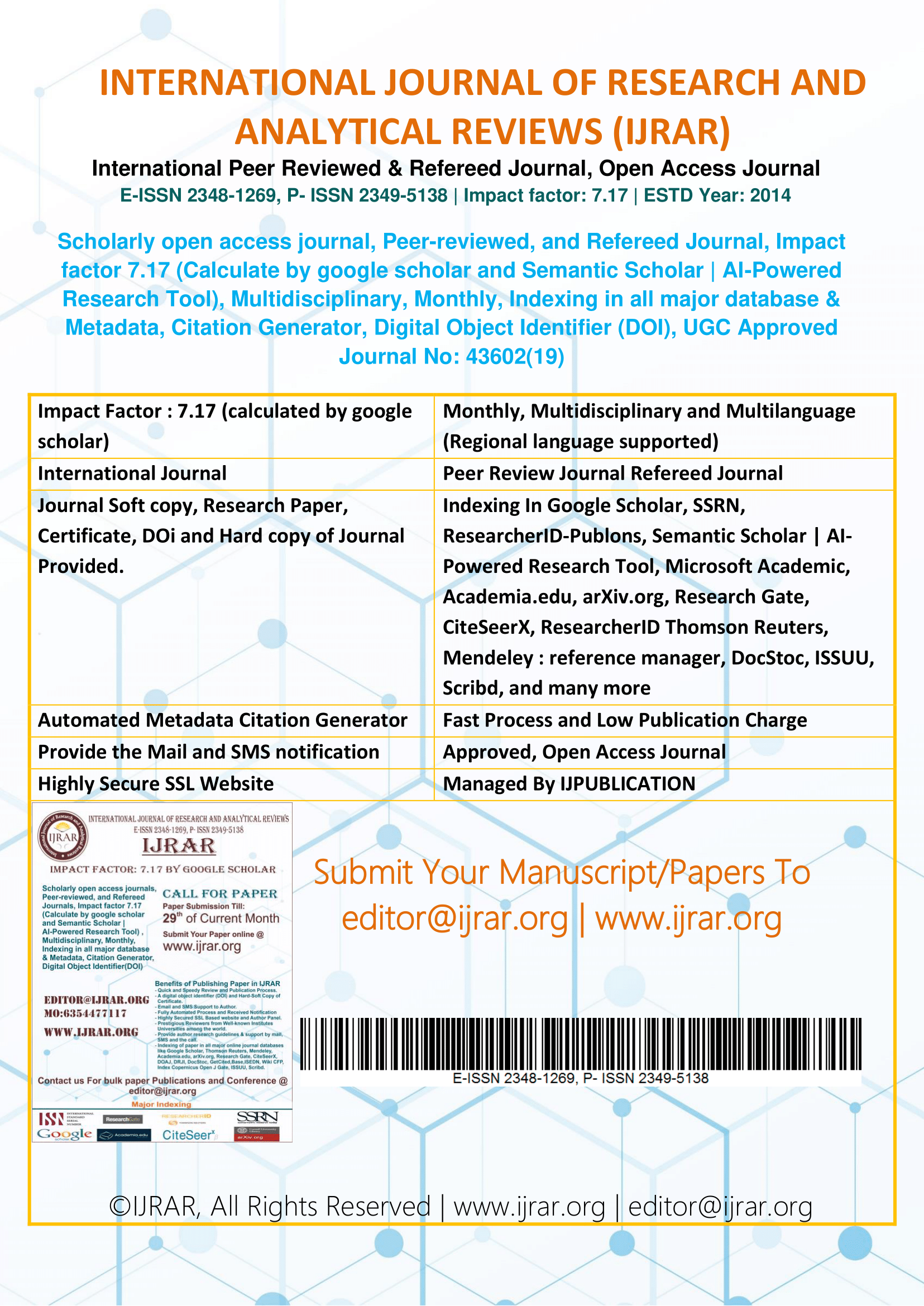
Read all new guidelines related publication before submission or publication. Scholarly open access , Peer-reviewed, and Refereed, Impact Factor: 7.17, AI-Powered Research Tool , Multidisciplinary, Monthly, Indexing in all major database & Metadata, Citation Generator, Digital Object Identifier(DOI), UGC Approved Journal No: 43602(19)
The INTERNATIONAL JOURNAL OF RESEARCH AND ANALYTICAL REVIEWS (IJRAR) aims to explore advances in research pertaining to applied, theoretical and experimental Technological studies. The goal is to promote scientific information interchange between researchers, developers, engineers, students, and practitioners working in and around the world.
Indexing In Google Scholar, ResearcherID Thomson Reuters, Mendeley : reference manager, Academia.edu, arXiv.org, Research Gate, CiteSeerX, DocStoc, ISSUU, Scribd, and many more INTERNATIONAL JOURNAL OF RESEARCH AND ANALYTICAL REVIEWS (IJRAR) E-ISSN 2348-1269, P- ISSN 2349-5138 | Impact factor: 7.17 | ESTD Year: 2014 | UGC and ISSN Approved. | Provide DOI and Hard copy of Certificate. Scholarly open access journals, Peer-reviewed, and Refereed Journals, AI-Powered Research Tool , Multidisciplinary, Monthly, Indexing in all major database & Metadata, Citation Generator, Digital Object Identifier(DOI) Low Open Access Publication Charge 1570 INR for indian author & 59$ for foreign International author..
Subject Category : Multidisciplinary, Monthly scholarly open access journals
Call For Paper (Volume 13 | Issue 4 | Month- November 2026)Paper Title: ClinicalStudyOfTimiraVyadhi
Publisher Journal Name: IJRAR, IJPUBLICATION
CrossRef DOI Member ID: 10.56975 Published Paper URL: http://ijrar.org/viewfull.php?&p_id=IJRAR26D1001 Published Paper PDF: download.php?file=IJRAR26D1001 Published Paper PDF: http://www.ijrar.org/papers/IJRAR26D1001.pdf
Published Paper ID: - IJRAR26D1001
Register Paper ID - 341068
Title: CLINICALSTUDYOFTIMIRAVYADHI
Author Name(s): DR ONKAR GAVADE, DR SANTOSH PUJAR, DR VINOD JADHAV, DR PRASHANT KALYANSHETTY
Publisher Journal name: IJRAR, IJPUBLICATION
DOI (Digital Object Identifier) :
Pubished in Volume: 13 | Issue: 4 | Year: October 2026
Volume: 13
Issue: 4
Pages: 1-3
Year: October 2026
Subject Area: Humanities All
Author type: Indian Author
Downloads: 196
In Ayurveda, Timira Vyadhi is a term referred to progressive visual disorder that can lead to complete blindness if left untreated. This vyadhi is classified under Drushtigataroga and can be correlated with modern refractive errors such as myopia, hypermetropia, and astigmatism. Myopia is a very common refractive error seen in children and young adults. There are various therapeutic procedures like Tarpan, Putpaak, Seka, Aschyotana, Anjana etc. Have been mentioned in Ayurveda for the management of Timir but Akshi-Tarpana is the foremost among it. But even then, neither proper acceptance nor precise scientific reasoning for the procedure is established. There are a lot of discrepancies found in the whole process. Drug absorption and mode of action are also big riddles to understand & explain to modern as well as Ayurvedic physicians, so that its acceptance and significance could be understood by the masses. In present research work it is tried to evaluate the efficacy of Akshi tarpan procedure with Shatavari Ghrita in simple myopia closely related to Timir in terms of symptoms, anatomical structures involved, and the pathogenesis of the disease.
Licence: creative commons attribution 4.0
Creative Commons Attribution 4.0 and The Open Definition


Timira, Akshi Tarpana, Myopia, Shatavari Ghrita.
Creative Commons Attribution 4.0 and The Open Definition
Paper Title: To Assess The Impact Of Startup India Initiatives On Employment Generation And Unemployment Reduction In Haryana.
Publisher Journal Name: IJRAR, IJPUBLICATION
CrossRef DOI Member ID: 10.56975 Published Paper URL: http://ijrar.org/viewfull.php?&p_id=IJRAR26D1002 Published Paper PDF: download.php?file=IJRAR26D1002 Published Paper PDF: http://www.ijrar.org/papers/IJRAR26D1002.pdf
Published Paper ID: - IJRAR26D1002
Register Paper ID - 341065
Title: TO ASSESS THE IMPACT OF STARTUP INDIA INITIATIVES ON EMPLOYMENT GENERATION AND UNEMPLOYMENT REDUCTION IN HARYANA.
Author Name(s): PREETI ATTRI, PROF SUNITA BHARTWAL
Publisher Journal name: IJRAR, IJPUBLICATION
DOI (Digital Object Identifier) :
Pubished in Volume: 13 | Issue: 4 | Year: October 2026
Volume: 13
Issue: 4
Pages: 4-14
Year: October 2026
Subject Area: Management All
Author type: Indian Author
Downloads: 153
The impact of Startup India initiatives on lowering young unemployment in Haryana is assessed in this study. Government-backed startup programs, which are intended to promote innovation, entrepreneurship, and economic growth, have become a key policy approach for tackling India's young employment issues. This study, which employs a mixed-methods research approach, looks at quantitative indicators including job creation rates, venture growth, and recruiting patterns as well as qualitative information obtained from student entrepreneurs, university incubators, and company founders in different Haryana districts. The results show that among recent graduates and young professionals, targeted startup interventions, incubation assistance, and seed funding channels have significantly increased entrepreneurial intent. These programs have created long-term work prospects in industries including technology, agriculture, manufacturing, and services by converting educated individuals from typical job searchers into job creators. Regional differences still exist, though, with tier-1 metropolitan hubs showing more policy absorption and employment creation than rural and semi-urban areas. In order to optimize the long-term impact of startup ecosystems on young employment throughout Haryana, the study closes with practical policy suggestions to increase financing availability, establish regional incubation centers, and develop university-industry ties.
Licence: creative commons attribution 4.0
Creative Commons Attribution 4.0 and The Open Definition
Keywords: Startup India, Youth Unemployment, Entrepreneurship Development, Haryana, Job Creation, University Incubators, Economic Policy.
Creative Commons Attribution 4.0 and The Open Definition
Paper Title: ACCESS TO EDUCATION FOR MARGINALIZED URBAN POPULATIONS THROUGH CORPORATION SCHOOLS
Publisher Journal Name: IJRAR, IJPUBLICATION
CrossRef DOI Member ID: 10.56975 Published Paper URL: http://ijrar.org/viewfull.php?&p_id=IJRAR26D1003 Published Paper PDF: download.php?file=IJRAR26D1003 Published Paper PDF: http://www.ijrar.org/papers/IJRAR26D1003.pdf
Published Paper ID: - IJRAR26D1003
Register Paper ID - 341061
Title: ACCESS TO EDUCATION FOR MARGINALIZED URBAN POPULATIONS THROUGH CORPORATION SCHOOLS
Author Name(s): MANOJ KUMAR M, Dr. S. SUNDARARAJAN
Publisher Journal name: IJRAR, IJPUBLICATION
DOI (Digital Object Identifier) :
Pubished in Volume: 13 | Issue: 4 | Year: October 2026
Volume: 13
Issue: 4
Pages: 15-21
Year: October 2026
Subject Area: Arts1 All
Author type: Indian Author
Downloads: 156
This paper examines the extent to which Urban Local Bodies (ULBs) in India, through the schools they directly manage -- commonly termed Corporation or Municipal Corporation schools -- ensure equitable access to education for marginalized urban populations. Marginalized groups in Indian cities, including migrant labour families, slum-dwelling households, and other economically disadvantaged communities, depend disproportionately on Corporation-managed schools as their primary, often sole, avenue to formal education, since these schools are tuition-free and located within or near low-income neighbourhoods. Drawing on secondary data from UDISE+ reports (2023-24 and 2024-25), national dropout and enrolment statistics, and existing research on urban educational access, the study analyses enrolment trends, social-category disparities, gender gaps, dropout patterns, and infrastructural constraints affecting access for marginalized populations. The findings indicate that while overall school enrolment in India has been gradually declining in absolute numbers, Scheduled Caste and Scheduled Tribe children remain under-represented relative to their population share at the secondary level, dropout rates rise sharply beyond the elementary stage, and school infrastructure gaps in digital and accessibility facilities continue to constrain effective access. The paper concludes with recommendations to strengthen the role of Urban Local Bodies as inclusive access providers for marginalized populations through targeted outreach, infrastructure investment, and stronger convergence with national access-oriented schemes.
Licence: creative commons attribution 4.0
Creative Commons Attribution 4.0 and The Open Definition
Urban Local Bodies; Corporation Schools; Marginalized Populations; Educational Access; Inclusive Education; School Enrolment; School Dropout; School Infrastructure; UDISE+; Educational Equity.
Creative Commons Attribution 4.0 and The Open Definition
Paper Title: From Female Experience To Protective Solidarity: A Postfeminist Reading Of Taylor Swift's "Patient Zero"
Publisher Journal Name: IJRAR, IJPUBLICATION
CrossRef DOI Member ID: 10.56975 Published Paper URL: http://ijrar.org/viewfull.php?&p_id=IJRAR26D1004 Published Paper PDF: download.php?file=IJRAR26D1004 Published Paper PDF: http://www.ijrar.org/papers/IJRAR26D1004.pdf
Published Paper ID: - IJRAR26D1004
Register Paper ID - 341059
Title: FROM FEMALE EXPERIENCE TO PROTECTIVE SOLIDARITY: A POSTFEMINIST READING OF TAYLOR SWIFT'S "PATIENT ZERO"
Author Name(s): Dipali Lodh
Publisher Journal name: IJRAR, IJPUBLICATION
DOI (Digital Object Identifier) :
Pubished in Volume: 13 | Issue: 4 | Year: October 2026
Volume: 13
Issue: 4
Pages: 22-26
Year: October 2026
Subject Area: Arts All
Author type: Indian Author
Downloads: 140
Taylor Swift's "Patient Zero," featuring Dakota Johnson and Colin Farrell, offers a significant representation of collective female solidarity by transforming one woman's lived experience into knowledge that can protect another woman. The song addresses a woman who recognises the danger surrounding a man because she has previously experienced it herself, while the music video translates this exchange into a supernatural encounter between Swift, the deceased first wife and Johnson, the second wife. This paper argues that the feminist significance of the song lies not simply in its depiction of women supporting women, but in its representation of female experience as transferable knowledge. Drawing upon Rosalind Gill's understanding of postfeminist agency, Angela McRobbie's account of the contradictions within postfeminist culture, bell hooks's emphasis on collective feminist consciousness, and Chandra Talpade Mohanty's conception of situated solidarity, the paper examines how "Patient Zero" moves from individual experience to testimony, recognition, solidarity, warning, and protection and shows how agency is relational and strengthened through female knowledge-sharing.
Licence: creative commons attribution 4.0
Creative Commons Attribution 4.0 and The Open Definition
Postfeminism, Female Testimony, Protective Solidarity, Women's Experience, Collective Feminism
Creative Commons Attribution 4.0 and The Open Definition
Paper Title: Education as an Engine of Human Development: Evidence from the Tribal Areas of Tripura, India
Publisher Journal Name: IJRAR, IJPUBLICATION
CrossRef DOI Member ID: 10.56975 Published Paper URL: http://ijrar.org/viewfull.php?&p_id=IJRAR26D1005 Published Paper PDF: download.php?file=IJRAR26D1005 Published Paper PDF: http://www.ijrar.org/papers/IJRAR26D1005.pdf
Published Paper ID: - IJRAR26D1005
Register Paper ID - 341049
Title: EDUCATION AS AN ENGINE OF HUMAN DEVELOPMENT: EVIDENCE FROM THE TRIBAL AREAS OF TRIPURA, INDIA
Author Name(s): Mr Nelmit Debbarma
Publisher Journal name: IJRAR, IJPUBLICATION
DOI (Digital Object Identifier) :
Pubished in Volume: 13 | Issue: 4 | Year: October 2026
Volume: 13
Issue: 4
Pages: 27-31
Year: October 2026
Subject Area: Arts All
Author type: Indian Author
Downloads: 148
Abstract Tripura, a small hill-and-plain state in India's North-East, has a Scheduled Tribe (ST) population of 11,66,813, which is 31.8 per cent of its people, spread over 19 recognised tribes. Two-thirds of the state's area falls under the Tripura Tribal Areas Autonomous District Council (TTAADC). This paper examines how education contributes to social, economic and political development in these tribal areas. Using secondary data (Census 2011, state statistical publications and departmental records) and four illustrative case studies, it argues that education works at three levels: it builds human capital, widens the freedoms people can exercise, and strengthens self-governance and cultural continuity. Tripura's ST literacy (79.05 per cent) is close to the national average of the general population but still trails the state average (87.22 per cent). The paper concludes that residential schooling, mother-tongue instruction and decentralised school governance are promising, while language-of-instruction conflicts, higher dropout among tribal children and weak transitions to higher education need sustained attention.
Licence: creative commons attribution 4.0
Creative Commons Attribution 4.0 and The Open Definition
Keywords: tribal education, human capital, Tripura, TTAADC, Sixth Schedule, Eklavya Model Residential Schools, mother-tongue instruction, inclusive development
Creative Commons Attribution 4.0 and The Open Definition
Paper Title: Study on Community-Based Biodiversity Conservation as a Sacred Grove in the Shekhawati Landscape of Thar Desert
Publisher Journal Name: IJRAR, IJPUBLICATION
CrossRef DOI Member ID: 10.56975 Published Paper URL: http://ijrar.org/viewfull.php?&p_id=IJRAR26D1006 Published Paper PDF: download.php?file=IJRAR26D1006 Published Paper PDF: http://www.ijrar.org/papers/IJRAR26D1006.pdf
Published Paper ID: - IJRAR26D1006
Register Paper ID - 341052
Title: STUDY ON COMMUNITY-BASED BIODIVERSITY CONSERVATION AS A SACRED GROVE IN THE SHEKHAWATI LANDSCAPE OF THAR DESERT
Author Name(s): Gulshan Jnvu, G.R. Parihar
Publisher Journal name: IJRAR, IJPUBLICATION
DOI (Digital Object Identifier) : https://doi.org/10.56975/ijrar.v13i4.341052
Pubished in Volume: 13 | Issue: 4 | Year: October 2026
Volume: 13
Issue: 4
Pages: 32-39
Year: October 2026
Subject Area: Life Sciences All
Author type: Indian Author
Downloads: 164
Sacred Groves, often referred to locally as Orans or Devbanis, are the main example of community-based biodiversity conservation in the Shekhawati landscape of the Thar Desert. Hunting, tree-felling, and agricultural activities are strictly forbidden in these village commons, which are controlled by the community and devoted to local deities. Ecological and Biological Significance Sacred woods function as "mini biosphere reserves" and habitat for wildlife in this parched area. In Shekhawati, conservation is more strongly ingrained in socioreligious customs than in official regulations. Community-Based Conservation Mechanisms Rather than formal laws, conservation in Shekhawati must be deeply rooted in socio-religious norms. It is emphasized that, in addition to conservation, appropriate use and management of this biodiversity is required to support agricultural and human needs. The plan should be such that the public supports it.
Licence: creative commons attribution 4.0
Creative Commons Attribution 4.0 and The Open Definition
Biodiversity Conservation, Sacred Grove, Shekhawati Landscape, Thar Desert
Creative Commons Attribution 4.0 and The Open Definition
Paper Title: Code Mixing and Code Switching in Select Bodo Novels: An Analysis
Publisher Journal Name: IJRAR, IJPUBLICATION
CrossRef DOI Member ID: 10.56975 Published Paper URL: http://ijrar.org/viewfull.php?&p_id=IJRAR26D1007 Published Paper PDF: download.php?file=IJRAR26D1007 Published Paper PDF: http://www.ijrar.org/papers/IJRAR26D1007.pdf
Published Paper ID: - IJRAR26D1007
Register Paper ID - 341024
Title: CODE MIXING AND CODE SWITCHING IN SELECT BODO NOVELS: AN ANALYSIS
Author Name(s): Khwmta Narzary, Bhoumik Chandra Baro
Publisher Journal name: IJRAR, IJPUBLICATION
DOI (Digital Object Identifier) :
Pubished in Volume: 13 | Issue: 4 | Year: October 2026
Volume: 13
Issue: 4
Pages: 40-53
Year: October 2026
Subject Area: Languages
Author type: Indian Author
Downloads: 153
Code-Mixing and Code-Switching are linguistic phenomena that occur in bilingual and multilingual societies to make communication more effective, attractive, and meaningful, and to clearly express thoughts. The use of Code-Mixing and Code-Switching is often observed during conversations as a medium of communication to better convey what speakers want to share. Code-Mixing occurs when words or phrases from one language are inserted into another language during communication. In contrast, Code Switching refers to the use of more than one language, variety, or style by a speaker within a single utterance or discourse. Code mixing and code switching in select Bodo novels reflect the dynamic nature of the Bodo language and its contact with other languages. Their use enriches the expression, dialogue, and characterization of the novels while representing the multilingual and changing socio-cultural realities of Bodo society. Thus, code mixing and code switching serve as important linguistic and literary devices in contemporary Bodo fiction. Apart from the English many languages were used in these select novels. But the only example of English is analysed.
Licence: creative commons attribution 4.0
Creative Commons Attribution 4.0 and The Open Definition
Code Mixing, Code Switching, Bodo Novel,
Creative Commons Attribution 4.0 and The Open Definition
Paper Title: Challenges in Teaching English at the College Level in Tribal Talukas of Sabarkantha District, Gujarat.
Publisher Journal Name: IJRAR, IJPUBLICATION
CrossRef DOI Member ID: 10.56975 Published Paper URL: http://ijrar.org/viewfull.php?&p_id=IJRAR26D1008 Published Paper PDF: download.php?file=IJRAR26D1008 Published Paper PDF: http://www.ijrar.org/papers/IJRAR26D1008.pdf
Published Paper ID: - IJRAR26D1008
Register Paper ID - 340939
Title: CHALLENGES IN TEACHING ENGLISH AT THE COLLEGE LEVEL IN TRIBAL TALUKAS OF SABARKANTHA DISTRICT, GUJARAT.
Author Name(s): Dr. Dilip R. Patel
Publisher Journal name: IJRAR, IJPUBLICATION
DOI (Digital Object Identifier) : https://doi.org/10.56975/ijrar.v13i4.340939
Pubished in Volume: 13 | Issue: 4 | Year: October 2026
Volume: 13
Issue: 4
Pages: 54-64
Year: October 2026
Subject Area: Arts All
Author type: Indian Author
Downloads: 156
This research paper analyzes the various problems of teaching English at the college level in the tribal Talukas of the Sabarkantha District of Gujarat State. The significance of this study is that the tribal region has its own educational characteristics where different cultural, linguistic and socio-economic reasons contribute to the complexity of English language teaching. The present study is an attempt to investigate the pedagogical, cultural and socio-economic challenges of English language teaching (ELT) at undergraduate college level in the tribal talukas of Vijaynagar, Khedbrahma and Poshina in Sabarkantha District of Gujarat. The research is based on Lev Vygotsky's Socio-Cultural Theory, Stephen Krashen's Second Language Acquisition hypotheses and Jim Cummins' Linguistic Interdependence Theory. The research examines the high cognitive and socio-educational load of indigenous learners. Data were collected from 200 undergraduate students and 10 active language educators in four colleges of tribal area of the sabarkantha district, using a mixed-methods concurrent triangulation design. To Implement the National Education Policy (NEP) 2020 and Indian Knowledge Systems (IKS), we recommend the development of trilingual bridge materials translating tribal oral folklore into English communicative tasks, shifting to low-anxiety Communicative Language Teaching, and targeted financial and digital infrastructure support.
Licence: creative commons attribution 4.0
Creative Commons Attribution 4.0 and The Open Definition
English language teaching, tribal education, Sabarkantha district, National Education Policy (NEP) 2020, Indian Knowledge Systems (IKS), language anxiety, socio-cultural theory.
Creative Commons Attribution 4.0 and The Open Definition
Paper Title: "A Study To Assess Knowledge Regarding Family Planning Among Eligible Couple in Rural area Simultala Jamui (Bihar)
Publisher Journal Name: IJRAR, IJPUBLICATION
CrossRef DOI Member ID: 10.56975 Published Paper URL: http://ijrar.org/viewfull.php?&p_id=IJRAR26D1009 Published Paper PDF: download.php?file=IJRAR26D1009 Published Paper PDF: http://www.ijrar.org/papers/IJRAR26D1009.pdf
Published Paper ID: - IJRAR26D1009
Register Paper ID - 341010
Title: "A STUDY TO ASSESS KNOWLEDGE REGARDING FAMILY PLANNING AMONG ELIGIBLE COUPLE IN RURAL AREA SIMULTALA JAMUI (BIHAR)
Author Name(s): Mr. Indresh Gupta, Surbhi Gupta, Ramkesh Verma, Boronali Chakraborty
Publisher Journal name: IJRAR, IJPUBLICATION
DOI (Digital Object Identifier) :
Pubished in Volume: 13 | Issue: 4 | Year: October 2026
Volume: 13
Issue: 4
Pages: 65-72
Year: October 2026
Subject Area: Health Science All
Author type: Indian Author
Downloads: 139
Introduction Family planning is sometimes used as a synonym or euphemism for the use of contraception. However, it often involves methods and practices in addition to contraception. NFHS-5 provides estimates of the contraceptive prevalence rate and unmet need for family planning. In Bihar, contraceptive use is higher in urban areas (62%) than in rural areas (55%). Contraceptive prevalence Objectives: to assess the level of knowledge regarding family planning among eligible couple selected rural area simultala.to find out association between knowledge and selected demographic variable. Methodology: Study design the research design selected for the present study was non experimental study in which descriptive study was adopted as research design. Sampling method Sampling is the process of selecting a portion of the population to obtain data regarding a problem. In this study the samples were selected through non-purposive sampling technique. Study population eligible couple Study area rural area Simultala Jamui Bihar. Study sample size is 250. Sampling is the process of selecting a portion of the population to obtain data regarding a problem. In this study the samples were selected through non-purposive sampling technique. Self-Structured Knowledge Questionnaire was used to find out about demographic data.Result Knowledge regarding family planning researcher found that Adequate Knowledge 62% moderate knowledge 21.2% and inadequate knowledge only 16.8% and association with demographic found significant with decision maker and occupation of adult. Conclusion The level of knowledge toward family planning was relatively low and people utilized of family planning method temporary and permanent were quite low in comparison with many studies.
Licence: creative commons attribution 4.0
Creative Commons Attribution 4.0 and The Open Definition
Knowledge, family planning, eligible couple rural area
Creative Commons Attribution 4.0 and The Open Definition
Paper Title: Yogini Dasha Kaal Mein Sambhavit Anisht Falon Ke Shaman Hetu Shanti Vidhan Evam Unka Shastriya Auchitya
Publisher Journal Name: IJRAR, IJPUBLICATION
CrossRef DOI Member ID: 10.56975 Published Paper URL: http://ijrar.org/viewfull.php?&p_id=IJRAR26D1010 Published Paper PDF: download.php?file=IJRAR26D1010 Published Paper PDF: http://www.ijrar.org/papers/IJRAR26D1010.pdf
Published Paper ID: - IJRAR26D1010
Register Paper ID - 340975
Title: YOGINI DASHA KAAL MEIN SAMBHAVIT ANISHT FALON KE SHAMAN HETU SHANTI VIDHAN EVAM UNKA SHASTRIYA AUCHITYA
Author Name(s): Manoj, Dr. Chudamani Trivedi
Publisher Journal name: IJRAR, IJPUBLICATION
DOI (Digital Object Identifier) :
Pubished in Volume: 13 | Issue: 4 | Year: October 2026
Volume: 13
Issue: 4
Pages: 73-77
Year: October 2026
Subject Area: Medical Science All
Author type: Indian Author
Downloads: 144
भारतीय वैदिक ज्योतिष में काल-निर्धारण एवं फलादेश के लिए विभिन्न दशा पद्धतियों का विधान है, जिनमें 'योगिनी दशा' का स्थान अत्यंत विशिष्ट एवं महत्वपूर्ण है। योगिनी दशा पद्धति (८ योगिनियाँ मङ्गला, पिंगला, धान्या, भ्रामरी, भद्रिका, उल्का, सिद्धा एवं सङ्कटा) कुल ३६ वर्षों के चक्र में जातक के जीवन चक्र को संचालित करती है। ज्योतिष शास्त्रों (यथा बृहत्पाराशर होराशास्त्र, उत्तरकालामृत एवं योगिनीदशाफलम्) के अनुसार, योगिनी दशा में उल्का, भ्रामरी, पिंगला और विशेष रूप से सङ्कटा दशा का काल जातक के जीवन में शारीरिक, मानसिक, आर्थिक एवं पारिवारिक अनिष्ट फलों की उत्पत्ति करता है। प्रस्तुत शोध पत्र योगिनी दशा काल में उत्पन्न होने वाले संभावित अनिष्ट प्रभावों, उनके शास्त्रीय कारणों तथा इनके शमन हेतु शास्त्रों में वर्णित वैदिक, पौराणिक एवं तांत्रिक शांति विधानों का अनुशीलन करता है। साथ ही, यह शोध पत्र इन शांति विधानों के मनोवैज्ञानिक, आध्यात्मिक तथा शास्त्रीय औचित्य का समालोचनात्मक अध्ययन प्रस्तुत करता है।
Licence: creative commons attribution 4.0
Creative Commons Attribution 4.0 and The Open Definition
योगिनी दशा, अनिष्ट फल, शांति विधान, ग्रह शांति, सङ्कटा, भ्रामरी, उल्का, वैदिक ज्योतिष, शास्त्रीय औचित्य।
Creative Commons Attribution 4.0 and The Open Definition
Paper Title: Clinical Trial to Evaluate the Effect of Varanadi Kwatha Bhavitha Shilajatu in Colorectal Carcinoma.
Publisher Journal Name: IJRAR, IJPUBLICATION
CrossRef DOI Member ID: 10.56975 Published Paper URL: http://ijrar.org/viewfull.php?&p_id=IJRAR26D1011 Published Paper PDF: download.php?file=IJRAR26D1011 Published Paper PDF: http://www.ijrar.org/papers/IJRAR26D1011.pdf
Published Paper ID: - IJRAR26D1011
Register Paper ID - 341020
Title: CLINICAL TRIAL TO EVALUATE THE EFFECT OF VARANADI KWATHA BHAVITHA SHILAJATU IN COLORECTAL CARCINOMA.
Author Name(s): ATHIRA U, Dr M M Abdul Shukkoor
Publisher Journal name: IJRAR, IJPUBLICATION
DOI (Digital Object Identifier) :
Pubished in Volume: 13 | Issue: 4 | Year: October 2026
Volume: 13
Issue: 4
Pages: 78-82
Year: October 2026
Subject Area: Humanities All
Author type: Indian Author
Downloads: 152
Introduction: Colorectal carcinoma is a prevalent gastrointestinal malignancy associated with high morbidity and treatment-related toxicities. Despite advancements in modern oncology, high recurrence rates diminish patient quality of life. In Ayurveda, this condition correlates with Arbuda, characterized by abnormal tissue growth from Tridosha vitiation affecting the Mamsa, Rakta, and Meda Dhatu. Integrative approaches using classical formulations provide essential supportive oncological care. This study evaluates the therapeutic effect of Varanadi Kwatha Bhavitha Shilajatu on Carcinoembryonic Antigen (CEA) levels and the overall quality of life in patients diagnosed with colorectal carcinoma. Materials and Methods: A single-group, pre-post interventional clinical trial was conducted at Government Ayurveda College Hospital, Tripunithura. Twenty-one diagnosed patients, aged 40 to 80 years, received 15 grams of Varanadi Kwatha Bhavitha Shilajatu orally, with 90 millilitres of Varanadi Kwatha as Anupana, twice daily for 30 days. Assessed parameters included CEA, Total White Blood Cell count, Erythrocyte Sedimentation Rate, Haemoglobin, Faecal Occult Blood, and the EORTC QLQ-CR29 questionnaire. Data were analyzed using paired t-tests, repeated measures ANOVA, Friedman test, and Cochran's Q test. Results: Mean CEA levels showed a statistically significant reduction from 6.28 to 5.92 ng/ml (p=0.008). Systemic inflammatory markers significantly decreased, while Haemoglobin and quality of life scores demonstrated highly significant improvements (p<0.001). Conversely, faecal bleeding positivity increased during the intervention. Discussion: Varanadi Kwatha Bhavitha Shilajatu is highly effective in managing key clinical parameters of colorectal carcinoma. The intervention successfully reduced tumour markers and systemic inflammation while significantly improving haemoglobin and patient quality of life. Despite increased faecal bleeding positivity, the overall outcomes highlight this formulation's substantial potential as a supportive adjuvant therapy in oncology.
Licence: creative commons attribution 4.0
Creative Commons Attribution 4.0 and The Open Definition
Arbuda, Carcinoembryonic antigen, Colorectal carcinoma, Shilajatu, Varanadi kwatha.
Creative Commons Attribution 4.0 and The Open Definition
Paper Title: Effect of McKenzie Extension Exercises on Pain and Lumbar Mobility in a 45-Year-Old Male Farmer with Chronic Low Back Pain: Case Study
Publisher Journal Name: IJRAR, IJPUBLICATION
CrossRef DOI Member ID: 10.56975 Published Paper URL: http://ijrar.org/viewfull.php?&p_id=IJRAR26D1012 Published Paper PDF: download.php?file=IJRAR26D1012 Published Paper PDF: http://www.ijrar.org/papers/IJRAR26D1012.pdf
Published Paper ID: - IJRAR26D1012
Register Paper ID - 341028
Title: EFFECT OF MCKENZIE EXTENSION EXERCISES ON PAIN AND LUMBAR MOBILITY IN A 45-YEAR-OLD MALE FARMER WITH CHRONIC LOW BACK PAIN: CASE STUDY
Author Name(s): Arsalan khan
Publisher Journal name: IJRAR, IJPUBLICATION
DOI (Digital Object Identifier) : https://doi.org/10.56975/ijrar.v13i4.341028
Pubished in Volume: 13 | Issue: 4 | Year: October 2026
Volume: 13
Issue: 4
Pages: 83-89
Year: October 2026
Subject Area: Humanities All
Author type: Indian Author
Downloads: 174
Background: Chronic low back pain is the most frequent musculoskeletal problem which might significantly affect the mobility, quality of life and occupational performance. Farmers have a lot of exposure to prolonged bending, lifting and other physically intensive activities which can lead to chronic low back pain. Case Description: A 42 years old male farmer, suffering from chronic low back pain for the period of 8 months, especially while performing prolonged bending, lifting, and farm work was seen at our outpatient department. Physical examination revealed limitation of lumbar spine movement, pain during flexion, weakness of trunk muscles and hips. Intervention: A 8-week physiotherapy rehabilitation program including McKenzie extension exercises was done on the patient. Outcome: The Numeric Pain Ra?ng Scale (NPRS), Oswestry Disability Index (ODI), lumbar spine movement range, Modified Schober Test, Manual Muscle Testing and Patient Specific Functional Scale (PSFS) were used for the evaluation of patients improvement. After rehabilitation, improvement in pain intensity, lumbar spine mobility, muscle strength, functional activity, tolerance to occupational ac?vi?es was observed. Conclusion: In conclusion, McKenzie extension exercise program, strengthening, postural correction and functional rehabilitation can be helpful in treating mechanical chronic low back pain. Structured rehabilitation program can improve functional independence and allow safe return to agriculture-related activities.
Licence: creative commons attribution 4.0
Creative Commons Attribution 4.0 and The Open Definition
Chronic Low Back Pain; McKenzie Extension Exercises; Physiotherapy; Lumbar Spine; Farmer; Exercise Therapy; Rehabilitation; Functional Disability; Postural Correction; Core strengthening.
Creative Commons Attribution 4.0 and The Open Definition