








IJRAR Peer-Reviewed (Refereed) Journal as Per New UGC Rules.
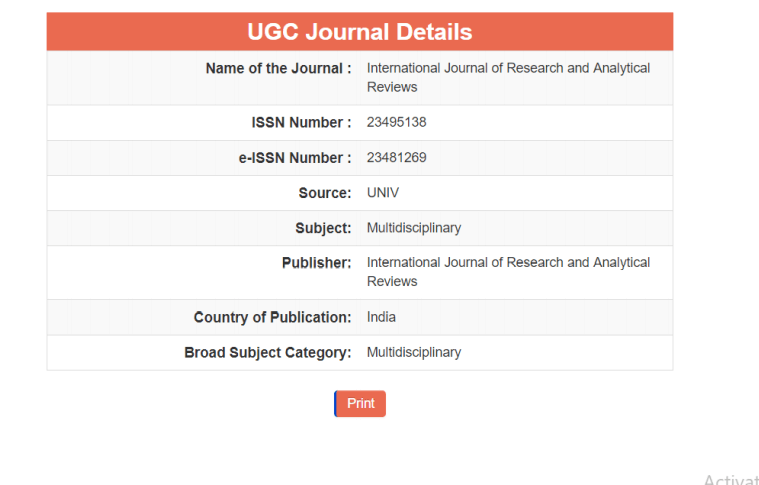
ISSN Approved Journal No: E-ISSN 2348-1269, P- ISSN 2349-5138
Journal ESTD Year: 2014 | CrossRef DOI
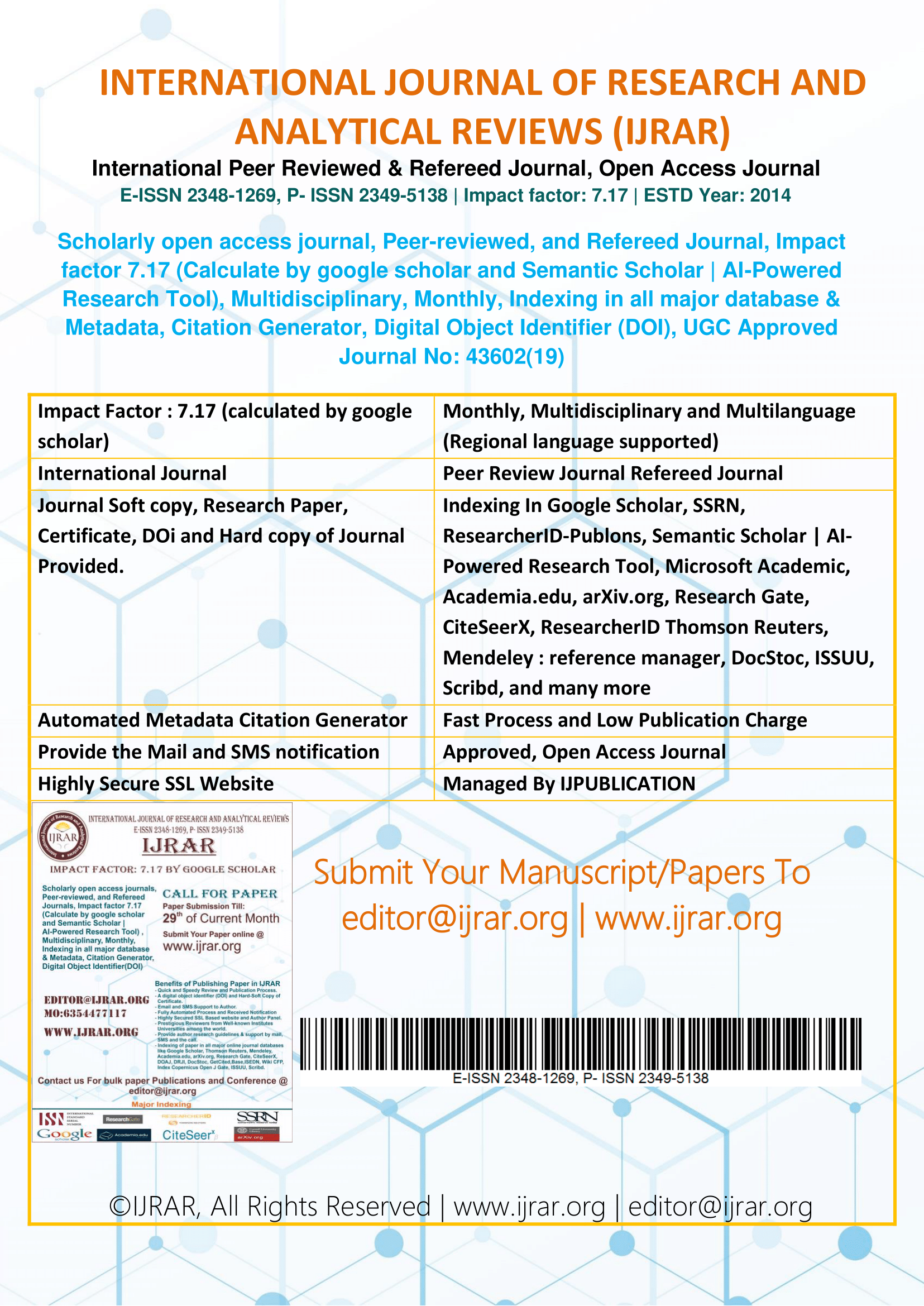
Read all new guidelines related publication before submission or publication. Scholarly open access , Peer-reviewed, and Refereed, Impact Factor: 7.17, AI-Powered Research Tool , Multidisciplinary, Monthly, Indexing in all major database & Metadata, Citation Generator, Digital Object Identifier(DOI), UGC Approved Journal No: 43602(19)
The INTERNATIONAL JOURNAL OF RESEARCH AND ANALYTICAL REVIEWS (IJRAR) aims to explore advances in research pertaining to applied, theoretical and experimental Technological studies. The goal is to promote scientific information interchange between researchers, developers, engineers, students, and practitioners working in and around the world.
Indexing In Google Scholar, ResearcherID Thomson Reuters, Mendeley : reference manager, Academia.edu, arXiv.org, Research Gate, CiteSeerX, DocStoc, ISSUU, Scribd, and many more INTERNATIONAL JOURNAL OF RESEARCH AND ANALYTICAL REVIEWS (IJRAR) E-ISSN 2348-1269, P- ISSN 2349-5138 | Impact factor: 7.17 | ESTD Year: 2014 | UGC and ISSN Approved. | Provide DOI and Hard copy of Certificate. Scholarly open access journals, Peer-reviewed, and Refereed Journals, AI-Powered Research Tool , Multidisciplinary, Monthly, Indexing in all major database & Metadata, Citation Generator, Digital Object Identifier(DOI) Low Open Access Publication Charge 1570 INR for indian author & 59$ for foreign International author..
Subject Category : Multidisciplinary, Monthly scholarly open access journals
Call For Paper (Volume 13 | Issue 3 | Month- September 2026)Paper Title: YOUTH EMPOWERMENT THROUGH SKILL DEVELOPMENT-A PATHWAY TO "VIKSIT BHARATH"@ 2047
Publisher Journal Name: IJRAR, IJPUBLICATION
CrossRef DOI Member ID: 10.56975 Published Paper URL: http://ijrar.org/viewfull.php?&p_id=IJRAR1EIP001 Published Paper PDF: download.php?file=IJRAR1EIP001 Published Paper PDF: http://www.ijrar.org/papers/IJRAR1EIP001.pdf
Published Paper ID: - IJRAR1EIP001
Register Paper ID - 326292
Title: YOUTH EMPOWERMENT THROUGH SKILL DEVELOPMENT-A PATHWAY TO "VIKSIT BHARATH"@ 2047
Author Name(s): Dr Gundeti Sunitha, Dr P Venkateswar rao
Publisher Journal name: IJRAR, IJPUBLICATION
DOI (Digital Object Identifier) :
Pubished in Volume: 13 | Issue: 1 | Year: January 2026
Volume: 13
Issue: 1
Pages: 1-6
Year: January 2026
Subject Area: Science and Technology
Author type: Indian Author
Downloads: 930
The word "Viksit Bharat" reflects the vision of the Indian government to be transformed as developed nation by 2047 i.e. at it's 100th independence day. This vision was framed under four pillars where first pillar is Youth (Yuva), whereas rest of three pillars included Poor (Garib), Women (Mahilayen) and farmers (Annadata). The great advantage of demographic dividend is possible through only skilful work force in the coming two decades. However, as compared to developed nations skilled work force in India is relatively very low, which is major obstacle for Viksit bharath, due to huge skill gap. As per the Skills Report 2024 highlights the need for collaboration and proactive measures and strategies to bridge the skill gap and prepare the workforce for the ever changing job market. The present study throws light on the challenges and strategies for Skilled India along with the discussion on the present government running skilled programmes in India. The study observed good positive impact of present government running skill development programmes at skill levels 1 and 2 which are suitable for unskilled and semi-skilled workforce. However, poor impact on high skilled work force. Therefore, the study suggests designing skill development programmes specifically for high skilled workforce.
Licence: creative commons attribution 4.0
Creative Commons Attribution 4.0 and The Open Definition


Skill India, Viksit Bharath, Youth Empowerment etc
Creative Commons Attribution 4.0 and The Open Definition
Paper Title: Digital Public Infrastructure and the Road to Viksit Bharat @2047: Efficiency, Inclusion, and the Future of India's Social Sector Transformation
Publisher Journal Name: IJRAR, IJPUBLICATION
CrossRef DOI Member ID: 10.56975 Published Paper URL: http://ijrar.org/viewfull.php?&p_id=IJRAR1EIP002 Published Paper PDF: download.php?file=IJRAR1EIP002 Published Paper PDF: http://www.ijrar.org/papers/IJRAR1EIP002.pdf
Published Paper ID: - IJRAR1EIP002
Register Paper ID - 326293
Title: DIGITAL PUBLIC INFRASTRUCTURE AND THE ROAD TO VIKSIT BHARAT @2047: EFFICIENCY, INCLUSION, AND THE FUTURE OF INDIA'S SOCIAL SECTOR TRANSFORMATION
Author Name(s): Dr. Chilukuri Venkat Reddy
Publisher Journal name: IJRAR, IJPUBLICATION
DOI (Digital Object Identifier) :
Pubished in Volume: 13 | Issue: 1 | Year: January 2026
Volume: 13
Issue: 1
Pages: 7-16
Year: January 2026
Subject Area: Science and Technology
Author type: Indian Author
Downloads: 680
India's vision of Viksit Bharat 2047 positions Digital Public Infrastructure (DPI) as the foundational engine for inclusive social and economic development. This study examines how DPI--through components such as Aadhaar, UPI, JAM, ABDM, and digital education platforms--has transformed governance, accelerated social outcomes, and reduced poverty. Using secondary quantitative analysis of the SDG India Index (2023-24) alongside policy reviews and academic literature, the research finds strong correlations between DPI maturity and improvements in poverty reduction, financial inclusion, and service delivery efficiency. However, persistent structural inequalities--including rural-urban access gaps, gender disparities, biometric failures, and emerging algorithmic risks--limit the full realization of inclusive growth. The study highlights Digital ShramSetu as a critical next-generation policy shift aimed at empowering 490 million informal workers through AI, blockchain, and Verifiable Credentials. Policy recommendations emphasize resilience-by-design, multi-factor authentication, digital literacy expansion, and stronger data ethics governance. The findings collectively underscore that DPI has catalysed India's development trajectory, but future progress toward Viksit Bharat 2047 requires prioritizing equity, accessibility, and technological trustworthiness.
Licence: creative commons attribution 4.0
Creative Commons Attribution 4.0 and The Open Definition
Digital Public Infrastructure, Viksit Bharat 2047, Financial Inclusion, Digital Divide, Social Policy Transformation, Digital ShramSetu
Creative Commons Attribution 4.0 and The Open Definition
Paper Title: Viksit Bharat @ 2047: Digital India - An Initiative Towards Transformation and Women Empowerment
Publisher Journal Name: IJRAR, IJPUBLICATION
CrossRef DOI Member ID: 10.56975 Published Paper URL: http://ijrar.org/viewfull.php?&p_id=IJRAR1EIP003 Published Paper PDF: download.php?file=IJRAR1EIP003 Published Paper PDF: http://www.ijrar.org/papers/IJRAR1EIP003.pdf
Published Paper ID: - IJRAR1EIP003
Register Paper ID - 326294
Title: VIKSIT BHARAT @ 2047: DIGITAL INDIA - AN INITIATIVE TOWARDS TRANSFORMATION AND WOMEN EMPOWERMENT
Author Name(s): Gajelly Mohan
Publisher Journal name: IJRAR, IJPUBLICATION
DOI (Digital Object Identifier) :
Pubished in Volume: 13 | Issue: 1 | Year: January 2026
Volume: 13
Issue: 1
Pages: 17-18
Year: January 2026
Subject Area: Science and Technology
Author type: Indian Author
Downloads: 624
Viksit Bharat @ 2047 is a visionary initiative by the Government of India aimed at transforming the nation into a developed, inclusive, and self-reliant economy by the year 2047, marking 100 years of India's independence. One of the most powerful pillars supporting this vision is the Digital India initiative, launched to bridge the digital divide and leverage technology as a catalyst for socio-economic development. Digital India focuses on creating robust digital infrastructure, delivering governance and services digitally, and empowering citizens through digital literacy. The initiative has revolutionized sectors such as education, healthcare, banking, governance, entrepreneurship, and communication. By enabling access to digital platforms, India has witnessed increased transparency, efficiency, and citizen participation in governance.
Licence: creative commons attribution 4.0
Creative Commons Attribution 4.0 and The Open Definition
Digital India - An Initiative Towards Transformation and Women Empowerment
Creative Commons Attribution 4.0 and The Open Definition
Paper Title: IMPACT OF DIGITAL INDIA ON WOMEN EMPOWERMENT
Publisher Journal Name: IJRAR, IJPUBLICATION
CrossRef DOI Member ID: 10.56975 Published Paper URL: http://ijrar.org/viewfull.php?&p_id=IJRAR1EIP004 Published Paper PDF: download.php?file=IJRAR1EIP004 Published Paper PDF: http://www.ijrar.org/papers/IJRAR1EIP004.pdf
Published Paper ID: - IJRAR1EIP004
Register Paper ID - 326295
Title: IMPACT OF DIGITAL INDIA ON WOMEN EMPOWERMENT
Author Name(s): Dr.N. Rajasree
Publisher Journal name: IJRAR, IJPUBLICATION
DOI (Digital Object Identifier) :
Pubished in Volume: 13 | Issue: 1 | Year: January 2026
Volume: 13
Issue: 1
Pages: 19-20
Year: January 2026
Subject Area: Science and Technology
Author type: Indian Author
Downloads: 596
The Digital India initiative launched by the Government of India aims to transform the country into a digitally empowered society and knowledge economy. One of its most significant impacts has been on women empowerment. Digital platforms have improved women's access to education, employment, entrepreneurship, financial inclusion, healthcare, and governance. This paper examines how Digital India has contributed to empowering women socially, economically, and politically, while also highlighting challenges and suggesting measures for inclusive digital growth.
Licence: creative commons attribution 4.0
Creative Commons Attribution 4.0 and The Open Definition
IMPACT OF DIGITAL INDIA ON WOMEN EMPOWERMENT
Creative Commons Attribution 4.0 and The Open Definition
Paper Title: Skill Development -A Glaring Hope for Vulnerable Youth
Publisher Journal Name: IJRAR, IJPUBLICATION
CrossRef DOI Member ID: 10.56975 Published Paper URL: http://ijrar.org/viewfull.php?&p_id=IJRAR1EIP005 Published Paper PDF: download.php?file=IJRAR1EIP005 Published Paper PDF: http://www.ijrar.org/papers/IJRAR1EIP005.pdf
Published Paper ID: - IJRAR1EIP005
Register Paper ID - 326296
Title: SKILL DEVELOPMENT -A GLARING HOPE FOR VULNERABLE YOUTH
Author Name(s): Dr.D.Makla
Publisher Journal name: IJRAR, IJPUBLICATION
DOI (Digital Object Identifier) :
Pubished in Volume: 13 | Issue: 1 | Year: January 2026
Volume: 13
Issue: 1
Pages: 21-24
Year: January 2026
Subject Area: Science and Technology
Author type: Indian Author
Downloads: 494
The vulnerable youth in India face significant challenges in accessing employment opportunities due to limited skills and education. Skill development is a critical intervention that can empower this demographic, enhancing their employability and socio-economic prospects. This paper explores the role of skill development in transforming the lives of vulnerable youth, highlighting its potential as a catalyst for social change. The study examines various skill development initiatives and programs aimed at equipping youth with industry-relevant skills, focusing on marginalized communities and disadvantaged backgrounds. It analyzes the impactof skill development on employability, income generation, and social mobility, identifying key challenges and opportunities for scaling up interventions. The paper argues that skill development is a crucial component of youth empowerment, enabling vulnerable populations to access better livelihood opportunities and break the cycle of poverty. It highlights the need for collaborative efforts between government, industry, and civil society to create a robust ecosystem for skill development, addressing gaps in infrastructure, curriculum, and trainer capacity. The study concludes that investing in skill development for vulnerable youth is a strategic imperative for India's socio-economic growth, promoting inclusive development and reducing inequality. It recommends policy interventions to enhance access, equity, and quality in skill development programs, ensuring that marginalized youth can realize their full potential land contribute to the nation's progress.
Licence: creative commons attribution 4.0
Creative Commons Attribution 4.0 and The Open Definition
Skill development, vulnerable youth, employability, socio-economic empowerment, inclusivee growth.
Creative Commons Attribution 4.0 and The Open Definition
Paper Title: Digital Transformation and Women Empowerment in India
Publisher Journal Name: IJRAR, IJPUBLICATION
CrossRef DOI Member ID: 10.56975 Published Paper URL: http://ijrar.org/viewfull.php?&p_id=IJRAR1EIP006 Published Paper PDF: download.php?file=IJRAR1EIP006 Published Paper PDF: http://www.ijrar.org/papers/IJRAR1EIP006.pdf
Published Paper ID: - IJRAR1EIP006
Register Paper ID - 326297
Title: DIGITAL TRANSFORMATION AND WOMEN EMPOWERMENT IN INDIA
Author Name(s): Dr. V. Jamuna
Publisher Journal name: IJRAR, IJPUBLICATION
DOI (Digital Object Identifier) :
Pubished in Volume: 13 | Issue: 1 | Year: January 2026
Volume: 13
Issue: 1
Pages: 25-27
Year: January 2026
Subject Area: Science and Technology
Author type: Indian Author
Downloads: 504
The paper deal with the status of Women empowerment . Women empowerment is empowering the women to take their own decisions for their personal growth and development as well as social development. Digital India is a flagship initiative of the Government of India aimed at transforming the country into a digitally empowered society and knowledge economy. Women empowerment is a crucial component of inclusive development, as women play a vital role in social and economic progress. The integration of digital technologies has opened new avenues for women by improving access to education, employment, healthcare, financial services, and governance. In states like Telangana, digital initiatives have significantly contributed to enhancing women's participation in economic and social activities. This article examines the role of Digital India in empowering women, with special reference to Telangana, highlighting opportunities, challenges, and future prospects.
Licence: creative commons attribution 4.0
Creative Commons Attribution 4.0 and The Open Definition
Digital India, Women Empowerment, Digital Literacy, Telangana, E-Governance, Entrepreneurship, Financial Inclusion
Creative Commons Attribution 4.0 and The Open Definition
Paper Title: From Digital Governance to Digital Empowerment: Analyzing India's Path to 2047
Publisher Journal Name: IJRAR, IJPUBLICATION
CrossRef DOI Member ID: 10.56975 Published Paper URL: http://ijrar.org/viewfull.php?&p_id=IJRAR1EIP007 Published Paper PDF: download.php?file=IJRAR1EIP007 Published Paper PDF: http://www.ijrar.org/papers/IJRAR1EIP007.pdf
Published Paper ID: - IJRAR1EIP007
Register Paper ID - 326298
Title: FROM DIGITAL GOVERNANCE TO DIGITAL EMPOWERMENT: ANALYZING INDIA'S PATH TO 2047
Author Name(s): Dr. G. Nagoji
Publisher Journal name: IJRAR, IJPUBLICATION
DOI (Digital Object Identifier) :
Pubished in Volume: 13 | Issue: 1 | Year: January 2026
Volume: 13
Issue: 1
Pages: 28-34
Year: January 2026
Subject Area: Science and Technology
Author type: Indian Author
Downloads: 631
The digital transformation process in India is one of the most widespread technological transformations in the modern history of government. The paper is an analysis of how India is changing the old governance systems to an ecosystem that is digitally enabled and an overview of how it is going to achieve the Viksit Bharat 2047 vision. The research methodology is mixed methods in nature, involving the use of secondary data in the form of government portals, policy documents, and empirical research to determine the effect of Digital Public Infrastructure (DPI) on financial inclusion, service delivery, and citizen empowerment. It has been found that India has reached some incredible milestones, such as more than 141.88 crore Aadhaar identifications, 16.73 billion monthly UPI transactions, and Direct Benefit Transfers of more than 43.36 lakh crore. For 2022-23, the contribution of the digital economy to the GDP has increased to 11.74% and as per the forecasts, it will increase to 13.42% in 2024-25. Nevertheless, ongoing problems such as the rural-urban digital gap, where rural internet adoption is only 35 percent as opposed to 70 percent in urban regions, and cybersecurity threats require strategic interventions. The paper ends by concluding that the DPI model that is known globally under the G20 presidency in India can be replicated in developing countries, but the model requires inclusive policies in ensuring a comprehensive digital empowerment of the population by 2047.
Licence: creative commons attribution 4.0
Creative Commons Attribution 4.0 and The Open Definition
Digital India, Digital Public Infrastructure, Viksit Bharat 2047, UPI, Aadhaar, e-Governance, Financial Inclusion, Digital Empowerment, India Stack, G20.
Creative Commons Attribution 4.0 and The Open Definition
Paper Title: Role of Information and Communication Technology (ICT) in Teaching Chemical Sciences: A Comprehensive Review
Publisher Journal Name: IJRAR, IJPUBLICATION
CrossRef DOI Member ID: 10.56975 Published Paper URL: http://ijrar.org/viewfull.php?&p_id=IJRAR1EIP008 Published Paper PDF: download.php?file=IJRAR1EIP008 Published Paper PDF: http://www.ijrar.org/papers/IJRAR1EIP008.pdf
Published Paper ID: - IJRAR1EIP008
Register Paper ID - 326299
Title: ROLE OF INFORMATION AND COMMUNICATION TECHNOLOGY (ICT) IN TEACHING CHEMICAL SCIENCES: A COMPREHENSIVE REVIEW
Author Name(s): Dr P. Surekha
Publisher Journal name: IJRAR, IJPUBLICATION
DOI (Digital Object Identifier) :
Pubished in Volume: 13 | Issue: 1 | Year: January 2026
Volume: 13
Issue: 1
Pages: 35-39
Year: January 2026
Subject Area: Science and Technology
Author type: Indian Author
Downloads: 484
Information and Communication Technology (ICT) has profoundly transformed the teaching-learning process across all academic disciplines, and chemical sciences are no exception. Chemistry is inherently abstract, experimental, and visualization-intensive, making it particularly well suited for technology-enhanced instruction. This comprehensive review examines the role of ICT tools--such as multimedia animations, virtual laboratories, molecular modelling software, learning management systems, online assessment platforms, and digitally controlled analytical instruments--in improving conceptual clarity, visualization, and practical competence in chemistry education. The pedagogical advantages of ICT integration include enhanced student engagement, interactive and learner-centered instruction, improved accessibility to global chemical resources, and the ability to bridge the gap between theory and experiment. The paper also critically evaluates the challenges associated with ICT adoption, including inadequate infrastructure, the digital divide, insufficient teacher training, high costs of licensed software, and the risk of reduced hands-on laboratory exposure. The review concludes that while ICT significantly enhances learning outcomes in chemical sciences, its long-term effectiveness depends on strategic investments, systematic teacher capacity-building, curriculum reforms, and sustainable policy support. When implemented judiciously through blended learning models, ICT has the potential to produce skilled, industry-ready, and research-oriented chemistry graduates.
Licence: creative commons attribution 4.0
Creative Commons Attribution 4.0 and The Open Definition
pedagogical approaches, animations, virtual laboratories, molecular modelling, ICT in chemistry education
Creative Commons Attribution 4.0 and The Open Definition
Paper Title: Smart Fields, Strong Farmers: Digital Technologies Advancing Modern Crop Cultivation
Publisher Journal Name: IJRAR, IJPUBLICATION
CrossRef DOI Member ID: 10.56975 Published Paper URL: http://ijrar.org/viewfull.php?&p_id=IJRAR1EIP009 Published Paper PDF: download.php?file=IJRAR1EIP009 Published Paper PDF: http://www.ijrar.org/papers/IJRAR1EIP009.pdf
Published Paper ID: - IJRAR1EIP009
Register Paper ID - 326300
Title: SMART FIELDS, STRONG FARMERS: DIGITAL TECHNOLOGIES ADVANCING MODERN CROP CULTIVATION
Author Name(s): Dr A. Rachana
Publisher Journal name: IJRAR, IJPUBLICATION
DOI (Digital Object Identifier) :
Pubished in Volume: 13 | Issue: 1 | Year: January 2026
Volume: 13
Issue: 1
Pages: 40-43
Year: January 2026
Subject Area: Science and Technology
Author type: Indian Author
Downloads: 573
Agriculture in the 21st century is undergoing a profound transformation driven by rapid advancements in digital technologies. Traditional farming practices are increasingly being supplemented--and in some cases replaced--by smart, data-driven, and technology-enabled solutions that enhance productivity, sustainability, and resilience. This paper examines a wide range of digitalised agricultural technologies that support farmers in modern crop cultivation, including precision farming, artificial intelligence (AI), machine learning (ML), Internet of Things (IoT), remote sensing, drones, mobile-based advisory services, digital marketplaces, smart irrigation systems, and farm management platforms [1][2][6]. The study highlights how these technologies enable informed decision-making, efficient resource utilisation, climate risk management, and improved crop yields. Special emphasis is placed on their relevance for small and marginal farmers in developing countries like India, where agriculture is both a livelihood and a critical component of food security. The paper also discusses major government initiatives, policy frameworks, and agri-tech innovations that promote the adoption of advanced digital tools in farming [3][4][7]. Despite challenges such as digital literacy gaps, infrastructure constraints, and data governance issues, digital agriculture holds immense potential to ensure food security, enhance farmers' incomes, and promote inclusive and sustainable agricultural development.
Licence: creative commons attribution 4.0
Creative Commons Attribution 4.0 and The Open Definition
Digital Agriculture, Smart Farming, Precision Agriculture, Crop Cultivation, Agricultural Technologies
Creative Commons Attribution 4.0 and The Open Definition
Paper Title: Artificial Intelligence in Agriculture: Opportunities, Challenges, and Future Prospects with Special Reference to Telangana State
Publisher Journal Name: IJRAR, IJPUBLICATION
CrossRef DOI Member ID: 10.56975 Published Paper URL: http://ijrar.org/viewfull.php?&p_id=IJRAR1EIP010 Published Paper PDF: download.php?file=IJRAR1EIP010 Published Paper PDF: http://www.ijrar.org/papers/IJRAR1EIP010.pdf
Published Paper ID: - IJRAR1EIP010
Register Paper ID - 326301
Title: ARTIFICIAL INTELLIGENCE IN AGRICULTURE: OPPORTUNITIES, CHALLENGES, AND FUTURE PROSPECTS WITH SPECIAL REFERENCE TO TELANGANA STATE
Author Name(s): Dr. B. M. Vinod Kumar
Publisher Journal name: IJRAR, IJPUBLICATION
DOI (Digital Object Identifier) :
Pubished in Volume: 13 | Issue: 1 | Year: January 2026
Volume: 13
Issue: 1
Pages: 44-50
Year: January 2026
Subject Area: Science and Technology
Author type: Indian Author
Downloads: 619
The agricultural sector in India is at a critical juncture due to rising population pressure, climate change, labour shortages, and declining natural resources. Artificial Intelligence (AI) has emerged as a transformative digital technology capable of addressing these challenges through data-driven decision-making, automation, and precision agriculture. Telangana State, with its proactive digital governance initiatives, diversified cropping pattern, and emphasis on technological innovation, provides a suitable context for examining the role of AI in agriculture. This paper analyses the applications, opportunities, and challenges of Artificial Intelligence in agriculture with special reference to Telangana State. It discusses AI-based precision farming, pest and disease detection, smart irrigation, drone technology, livestock monitoring, and market intelligence systems. The paper also highlights Telangana-specific initiatives such as digital crop surveys, satellite-based monitoring, and drone-based agricultural services. Despite the promising prospects, the adoption of AI faces challenges including high costs, infrastructural gaps, digital illiteracy, data privacy concerns, and regulatory issues. The study concludes with policy recommendations aimed at ensuring inclusive, sustainable, and farmer-centric AI adoption.
Licence: creative commons attribution 4.0
Creative Commons Attribution 4.0 and The Open Definition
Artificial Intelligence, Precision Farming, Smart Agriculture, Telangana, Digital India, Sustainability
Creative Commons Attribution 4.0 and The Open Definition
Paper Title: Women Empowerment in India: Challenges and Opportunities
Publisher Journal Name: IJRAR, IJPUBLICATION
CrossRef DOI Member ID: 10.56975 Published Paper URL: http://ijrar.org/viewfull.php?&p_id=IJRAR1EIP011 Published Paper PDF: download.php?file=IJRAR1EIP011 Published Paper PDF: http://www.ijrar.org/papers/IJRAR1EIP011.pdf
Published Paper ID: - IJRAR1EIP011
Register Paper ID - 326302
Title: WOMEN EMPOWERMENT IN INDIA: CHALLENGES AND OPPORTUNITIES
Author Name(s): Dr.Kathi Saraswathi
Publisher Journal name: IJRAR, IJPUBLICATION
DOI (Digital Object Identifier) :
Pubished in Volume: 13 | Issue: 1 | Year: January 2026
Volume: 13
Issue: 1
Pages: 51-56
Year: January 2026
Subject Area: Science and Technology
Author type: Indian Author
Downloads: 543
Women Empowerment Is One of the And Key Drivers of Inclusive and Sustainable Development in Any Society. In India, The Discourse on Empowering Women Has Gained Momentum in Recent Decades Due To Growing Awareness, Supportive Legislation, International Influence. Despite , Women Still Face Structural Barriers That Hinder Their Full Participation in Socio-Economic and Political Life. This Research Paper Critically Examines the Multifaceted Challenges Faced by Indian Women in Their Journey Towards Empowerment and Highlights the Opportunities That Can Be Harnessed to Promote Gender Equality and Self-Reliance, Especially Within the Vision of Atmanirbhar Bharat (Self-Reliant India). It Also Recommends Holistic Strategies for Bridging the Gap Between Policy and Practice, Aiming to Create a More Inclusive and Equitable Society.
Licence: creative commons attribution 4.0
Creative Commons Attribution 4.0 and The Open Definition
Women Empowerment, Gender Equality, Self-Reliant India, Challenges, Opportunities, Social Barriers, Economic Participation, Education, Digital Inclusion, Entrepreneurship
Creative Commons Attribution 4.0 and The Open Definition
Paper Title: Digital Empowerment of Farmers in 21st Centuryin India
Publisher Journal Name: IJRAR, IJPUBLICATION
CrossRef DOI Member ID: 10.56975 Published Paper URL: http://ijrar.org/viewfull.php?&p_id=IJRAR1EIP012 Published Paper PDF: download.php?file=IJRAR1EIP012 Published Paper PDF: http://www.ijrar.org/papers/IJRAR1EIP012.pdf
Published Paper ID: - IJRAR1EIP012
Register Paper ID - 326303
Title: DIGITAL EMPOWERMENT OF FARMERS IN 21ST CENTURYIN INDIA
Author Name(s): Dr. Bala Srinivas
Publisher Journal name: IJRAR, IJPUBLICATION
DOI (Digital Object Identifier) :
Pubished in Volume: 13 | Issue: 1 | Year: January 2026
Volume: 13
Issue: 1
Pages: 57-67
Year: January 2026
Subject Area: Science and Technology
Author type: Indian Author
Downloads: 731
The rapid expansion of digital technologies in 21st-century India has brought significant transformation to the agricultural sector, reshaping the way farmers access information, markets, and government services. This study examines the extent and impact of digital empowerment among farmers in the context of evolving digital infrastructure, policy interventions, and technological innovations. Aligned with the study objectives, the research explores how rural connectivity, mobile penetration, and digital platforms have enhanced farmers' decision-making capabilities, improved productivity, and facilitated timely access to critical information on weather, market prices, crop advisory, and input management.The study further evaluates the effectiveness of major government initiatives--including Digital India, the Digital Agriculture Mission, PM-KISAN, e-NAM, Soil Health Card digitalization, and online procurement systems--in strengthening transparency, efficiency, and financial inclusion for farmers. It analyzes the emerging role of digital marketing systems and agritech solutions, highlighting how online marketplaces, digital payment systems, and precision farming technologies are expanding market linkages and promoting sustainable agricultural practices in India. The study also assesses farmers' levels of digital literacy and adoption, identifying gaps related to technological awareness, affordability, and access to regional-language content. Finally, the study identifies critical challenges such as limited digital infrastructure in remote regions, socio-economic barriers faced by small and marginal farmers, and the existing digital divide that restricts inclusive digital participation. The findings underscore the need for stronger digital literacy programs, improved rural connectivity, farmer-centric innovations, and integrated digital platforms to ensure equitable and widespread digital empowerment. Overall, the study concludes that digital transformation has immense potential to enhance productivity, resilience, and livelihood security in Indian agriculture, provided that inclusive and sustainable digital strategies are implemented effectively.
Licence: creative commons attribution 4.0
Creative Commons Attribution 4.0 and The Open Definition
Digital empowerment, Technological awareness, Financial Inclusion, farmer centric innovations and Sustainable digital strategies
Creative Commons Attribution 4.0 and The Open Definition